SUBSCRIBE TO OUR FREE NEWSLETTER
Daily news & progressive opinion—funded by the people, not the corporations—delivered straight to your inbox.
5
#000000
#FFFFFF
To donate by check, phone, or other method, see our More Ways to Give page.
Daily news & progressive opinion—funded by the people, not the corporations—delivered straight to your inbox.
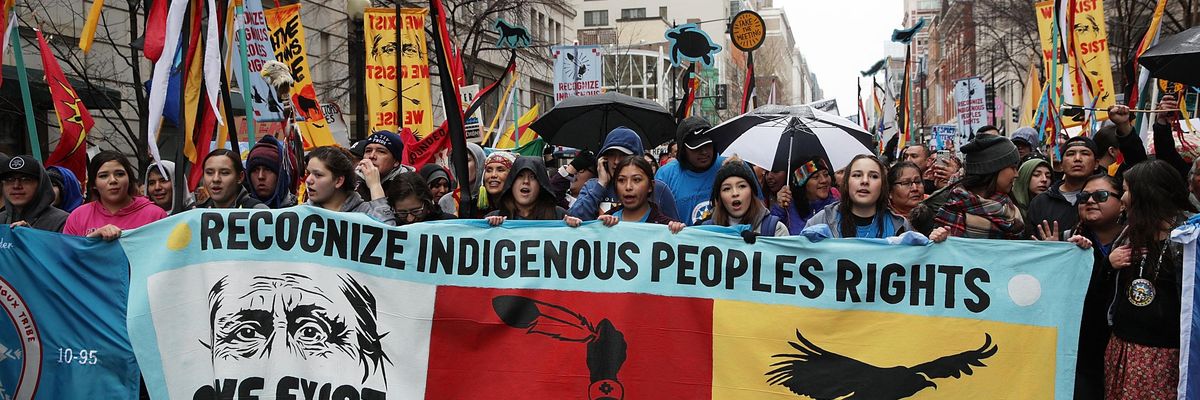
Activists participate in a protest against the Dakota Access Pipeline on March 10, 2017 in Washington, DC. (Photo: Alex Wong/Getty Images)
As he leaves for work each day, Jeff Kelly, the Standing Rock Sioux Tribe Fish and Game Department director looks out at the Dakota Access Pipeline (DAPL) crossing the Missouri River near his home. "I pray that the pipeline does not break today," he often says to himself, thinking of the more than 500,000 barrels of oil that flow underneath Lake Oahe daily.
DAPL crosses the Missouri River and Lake Oahe about 800 feet upstream of the tribe's Reservation and Cannonball Community, where Director Kelly lives. For more than five years, Standing Rock has lived with the looming threat that an oil spill may destroy treaty homelands, natural and cultural resources, sacred sites, and drinking waters.
The proximity of DAPL to Standing Rock is no coincidence. The pipeline was originally routed to cross the Missouri River just north of Bismarck, N.D., but concerns that an oil spill could pollute the drinking waters of the state capital convinced project planners to go back to the drawing board. The U.S. Army Corps of Engineers hastily approved a new pipeline route near the tribe using a streamlined permitting process that, this time, concluded with an issuance of a Finding of No Significant Impact.
Today, with the worsening impacts of drought and climate change, the threat to the Standing Rock community is even more grave. The Missouri River is currently at historically low water levels, making boat launches near the pipeline unusable and surrounded by mud. If an oil spill were to occur, emergency response boat travel around the DAPL crossing--the critical zone for oil spill remediation--would be close to impossible in the increasingly shallow depths.
The tribes' concerns and needs around the pipeline keep getting ignored. Just last year, the Army Corps failed to disclose critical data that Standing Rock needed to draft its own threat assessments and emergency response plans. The tribe felt they had no viable remaining option but to withdraw their status as a Cooperating Agency.
H.R. 2021, the Environmental Justice for All Act, offers a solution for both Standing Rock and countless other communities across the country that are facing these kinds of injustices. The bill, which is being voted on by the U.S. House Committee on Natural Resources this Wednesday, July 27, would ensure that the communities most affected by federal actions like permits and environmental reviews have a seat at the table in the decision-making process.
The Environmental Justice For All Act also adds to the considerations that federal agencies must make before issuing Clean Water and Clean Air Act permits. If a project cannot demonstrate that there will be no harm to human health, the permit will not be issued. For Standing Rock, that would mean that the Army Corps would have had to consider the serious threats of DAPL to the water quality of the Missouri River, the tribe's primary source of drinking water, before issuing a permit.
In addition, the Environmental Justice For All Act requires federal agencies to prepare a "community impact report" and mandates early involvement opportunities for affected communities under the National Environmental Policy Act (NEPA). Army Corps would not be able to get away with ignoring communities like Standing Rock again.
While the situation for Standing Rock is unquestionably dire, it's unfortunately nothing new. Across the country, polluting industries have been expediting dirty, dangerous projects in communities that don't have enough political influence or high-income brackets to stop them. Standing Rock Sioux Tribe's fight for transparency, accountability, and justice is one that resonates with far too many Americans.
Until Congress passes the Environmental Justice For All Act, this disturbing status quo is the law of the land. When the committee takes a vote on the bill this Wednesday, it's an opportunity for us to finally take a stand and show communities like Standing Rock that their lives and wellbeing are more valuable than another industry profit windfall. It's a moment to show the 140 million Americans who are poor or low income that their health and safety can't be bought and sold.
For Standing Rock, environmental justice has been elusive since the U.S. government first flooded the forests, wildlife, and agricultural lands along the Missouri River in order to create Lake Oahe. DAPL adds another grim chapter to that story. With the Environmental Justice For All Act, we have a chance to start over with a new history that treats every American with the dignity and respect they deserve. Let's not miss it.
Dear Common Dreams reader, It’s been nearly 30 years since I co-founded Common Dreams with my late wife, Lina Newhouser. We had the radical notion that journalism should serve the public good, not corporate profits. It was clear to us from the outset what it would take to build such a project. No paid advertisements. No corporate sponsors. No millionaire publisher telling us what to think or do. Many people said we wouldn't last a year, but we proved those doubters wrong. Together with a tremendous team of journalists and dedicated staff, we built an independent media outlet free from the constraints of profits and corporate control. Our mission has always been simple: To inform. To inspire. To ignite change for the common good. Building Common Dreams was not easy. Our survival was never guaranteed. When you take on the most powerful forces—Wall Street greed, fossil fuel industry destruction, Big Tech lobbyists, and uber-rich oligarchs who have spent billions upon billions rigging the economy and democracy in their favor—the only bulwark you have is supporters who believe in your work. But here’s the urgent message from me today. It's never been this bad out there. And it's never been this hard to keep us going. At the very moment Common Dreams is most needed, the threats we face are intensifying. We need your support now more than ever. We don't accept corporate advertising and never will. We don't have a paywall because we don't think people should be blocked from critical news based on their ability to pay. Everything we do is funded by the donations of readers like you. When everyone does the little they can afford, we are strong. But if that support retreats or dries up, so do we. Will you donate now to make sure Common Dreams not only survives but thrives? —Craig Brown, Co-founder |
As he leaves for work each day, Jeff Kelly, the Standing Rock Sioux Tribe Fish and Game Department director looks out at the Dakota Access Pipeline (DAPL) crossing the Missouri River near his home. "I pray that the pipeline does not break today," he often says to himself, thinking of the more than 500,000 barrels of oil that flow underneath Lake Oahe daily.
DAPL crosses the Missouri River and Lake Oahe about 800 feet upstream of the tribe's Reservation and Cannonball Community, where Director Kelly lives. For more than five years, Standing Rock has lived with the looming threat that an oil spill may destroy treaty homelands, natural and cultural resources, sacred sites, and drinking waters.
The proximity of DAPL to Standing Rock is no coincidence. The pipeline was originally routed to cross the Missouri River just north of Bismarck, N.D., but concerns that an oil spill could pollute the drinking waters of the state capital convinced project planners to go back to the drawing board. The U.S. Army Corps of Engineers hastily approved a new pipeline route near the tribe using a streamlined permitting process that, this time, concluded with an issuance of a Finding of No Significant Impact.
Today, with the worsening impacts of drought and climate change, the threat to the Standing Rock community is even more grave. The Missouri River is currently at historically low water levels, making boat launches near the pipeline unusable and surrounded by mud. If an oil spill were to occur, emergency response boat travel around the DAPL crossing--the critical zone for oil spill remediation--would be close to impossible in the increasingly shallow depths.
The tribes' concerns and needs around the pipeline keep getting ignored. Just last year, the Army Corps failed to disclose critical data that Standing Rock needed to draft its own threat assessments and emergency response plans. The tribe felt they had no viable remaining option but to withdraw their status as a Cooperating Agency.
H.R. 2021, the Environmental Justice for All Act, offers a solution for both Standing Rock and countless other communities across the country that are facing these kinds of injustices. The bill, which is being voted on by the U.S. House Committee on Natural Resources this Wednesday, July 27, would ensure that the communities most affected by federal actions like permits and environmental reviews have a seat at the table in the decision-making process.
The Environmental Justice For All Act also adds to the considerations that federal agencies must make before issuing Clean Water and Clean Air Act permits. If a project cannot demonstrate that there will be no harm to human health, the permit will not be issued. For Standing Rock, that would mean that the Army Corps would have had to consider the serious threats of DAPL to the water quality of the Missouri River, the tribe's primary source of drinking water, before issuing a permit.
In addition, the Environmental Justice For All Act requires federal agencies to prepare a "community impact report" and mandates early involvement opportunities for affected communities under the National Environmental Policy Act (NEPA). Army Corps would not be able to get away with ignoring communities like Standing Rock again.
While the situation for Standing Rock is unquestionably dire, it's unfortunately nothing new. Across the country, polluting industries have been expediting dirty, dangerous projects in communities that don't have enough political influence or high-income brackets to stop them. Standing Rock Sioux Tribe's fight for transparency, accountability, and justice is one that resonates with far too many Americans.
Until Congress passes the Environmental Justice For All Act, this disturbing status quo is the law of the land. When the committee takes a vote on the bill this Wednesday, it's an opportunity for us to finally take a stand and show communities like Standing Rock that their lives and wellbeing are more valuable than another industry profit windfall. It's a moment to show the 140 million Americans who are poor or low income that their health and safety can't be bought and sold.
For Standing Rock, environmental justice has been elusive since the U.S. government first flooded the forests, wildlife, and agricultural lands along the Missouri River in order to create Lake Oahe. DAPL adds another grim chapter to that story. With the Environmental Justice For All Act, we have a chance to start over with a new history that treats every American with the dignity and respect they deserve. Let's not miss it.
As he leaves for work each day, Jeff Kelly, the Standing Rock Sioux Tribe Fish and Game Department director looks out at the Dakota Access Pipeline (DAPL) crossing the Missouri River near his home. "I pray that the pipeline does not break today," he often says to himself, thinking of the more than 500,000 barrels of oil that flow underneath Lake Oahe daily.
DAPL crosses the Missouri River and Lake Oahe about 800 feet upstream of the tribe's Reservation and Cannonball Community, where Director Kelly lives. For more than five years, Standing Rock has lived with the looming threat that an oil spill may destroy treaty homelands, natural and cultural resources, sacred sites, and drinking waters.
The proximity of DAPL to Standing Rock is no coincidence. The pipeline was originally routed to cross the Missouri River just north of Bismarck, N.D., but concerns that an oil spill could pollute the drinking waters of the state capital convinced project planners to go back to the drawing board. The U.S. Army Corps of Engineers hastily approved a new pipeline route near the tribe using a streamlined permitting process that, this time, concluded with an issuance of a Finding of No Significant Impact.
Today, with the worsening impacts of drought and climate change, the threat to the Standing Rock community is even more grave. The Missouri River is currently at historically low water levels, making boat launches near the pipeline unusable and surrounded by mud. If an oil spill were to occur, emergency response boat travel around the DAPL crossing--the critical zone for oil spill remediation--would be close to impossible in the increasingly shallow depths.
The tribes' concerns and needs around the pipeline keep getting ignored. Just last year, the Army Corps failed to disclose critical data that Standing Rock needed to draft its own threat assessments and emergency response plans. The tribe felt they had no viable remaining option but to withdraw their status as a Cooperating Agency.
H.R. 2021, the Environmental Justice for All Act, offers a solution for both Standing Rock and countless other communities across the country that are facing these kinds of injustices. The bill, which is being voted on by the U.S. House Committee on Natural Resources this Wednesday, July 27, would ensure that the communities most affected by federal actions like permits and environmental reviews have a seat at the table in the decision-making process.
The Environmental Justice For All Act also adds to the considerations that federal agencies must make before issuing Clean Water and Clean Air Act permits. If a project cannot demonstrate that there will be no harm to human health, the permit will not be issued. For Standing Rock, that would mean that the Army Corps would have had to consider the serious threats of DAPL to the water quality of the Missouri River, the tribe's primary source of drinking water, before issuing a permit.
In addition, the Environmental Justice For All Act requires federal agencies to prepare a "community impact report" and mandates early involvement opportunities for affected communities under the National Environmental Policy Act (NEPA). Army Corps would not be able to get away with ignoring communities like Standing Rock again.
While the situation for Standing Rock is unquestionably dire, it's unfortunately nothing new. Across the country, polluting industries have been expediting dirty, dangerous projects in communities that don't have enough political influence or high-income brackets to stop them. Standing Rock Sioux Tribe's fight for transparency, accountability, and justice is one that resonates with far too many Americans.
Until Congress passes the Environmental Justice For All Act, this disturbing status quo is the law of the land. When the committee takes a vote on the bill this Wednesday, it's an opportunity for us to finally take a stand and show communities like Standing Rock that their lives and wellbeing are more valuable than another industry profit windfall. It's a moment to show the 140 million Americans who are poor or low income that their health and safety can't be bought and sold.
For Standing Rock, environmental justice has been elusive since the U.S. government first flooded the forests, wildlife, and agricultural lands along the Missouri River in order to create Lake Oahe. DAPL adds another grim chapter to that story. With the Environmental Justice For All Act, we have a chance to start over with a new history that treats every American with the dignity and respect they deserve. Let's not miss it.